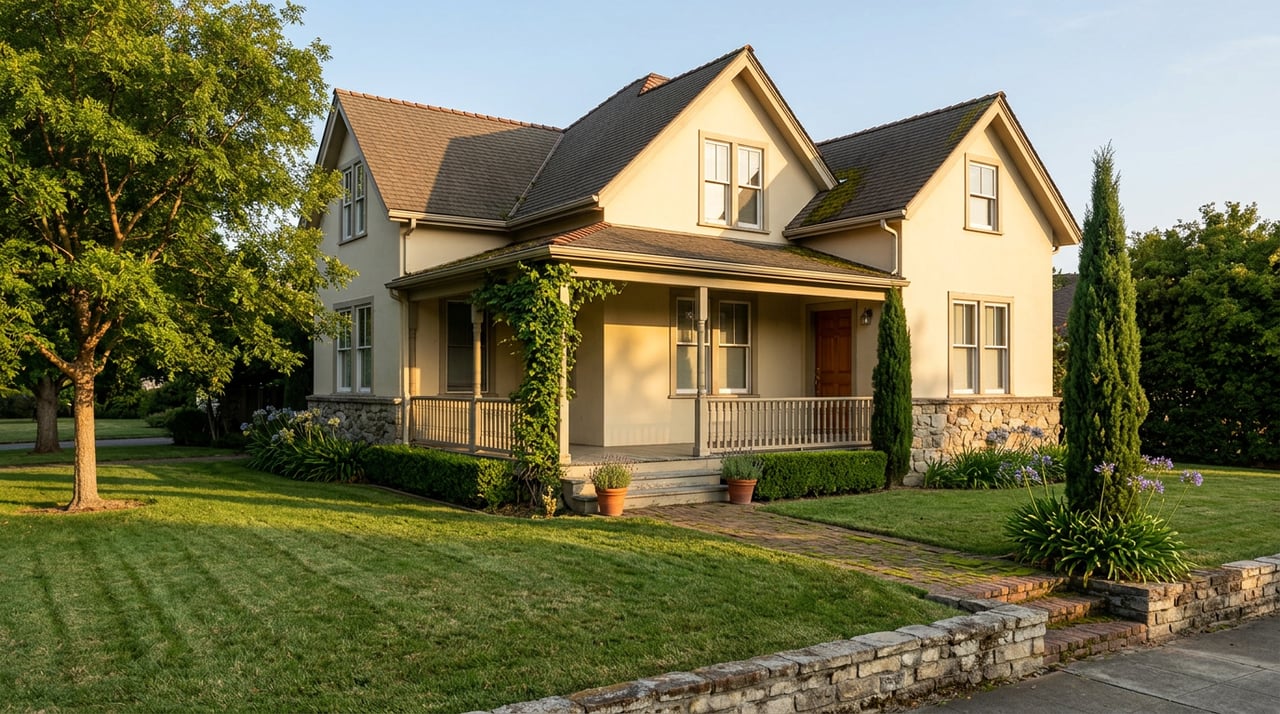
Benicia's Two Historic Districts Are Sending Opposite Price Signals. Here's Why That Matters for Buyers.
September 24, 2026
September 24, 2026
Pull up two Benicia neighborhood pages side by side and you'll see numbers that don't belong in the same city. Historic Downtown Benicia posted a median sale price of $1.6 million over the three months ending March 2026, up 90.5 percent from the same period a year earlier. A few blocks away, the Benicia Arsenal Historic District posted a median of $335,000 over that same window, down 26.4 percent. Same city. Same word "historic" in both names. Opposite directions, and not by a little.
If you're comparing Benicia neighborhoods for a move, this is the kind of number that either scares you off or talks you into something. It shouldn't do either, because neither figure is really describing the market. Both are describing something narrower: how few homes actually change hands in these small, boundary-drawn pockets, and how much a single sale can swing a median when the sample is that thin.
Here's the detail that explains everything: Historic Downtown Benicia averages roughly one home sale per month. The Arsenal Historic District has recorded periods with exactly one sale in the trailing month as well. When your entire dataset for a neighborhood is one or two closings, a single move-up buyer who overpays for a First Street Victorian, or a single investor who unloads a small Arsenal-area condo below market, doesn't nudge the median. It becomes the median. The percentage change headline isn't wrong, it's just not measuring what it looks like it's measuring.
Compare that to the city as a whole. Benicia's citywide median sale price was $822,456 as of August 2026, up 10.0 percent year over year, built from around 28 to 30 closings a month across houses, condos, townhouses and multi-family units. That's a real trend line, because it has enough transactions behind it to average out the noise. The two historic sub-district numbers don't have that luxury.
Here's how the picture looks when you set the pieces next to each other:
| Area | Median sale price | YoY change | Window |
|---|---|---|---|
| Historic Downtown Benicia | $1.6M | +90.5% | 3 mo. ending Mar 2026 |
| Benicia Arsenal Historic District | $335K | -26.4% | 3 mo. ending Mar 2026 |
| West Side | $926,188 | +1.2% | May 2026 |
| Eastside | $649,781 | -13.2% | May 2026 |
| Benicia, citywide | $822,456 | +10.0% | Aug 2026 |
Notice that West Side and Eastside, both larger areas with more regular turnover, land much closer to the citywide trend than either historic district does. That's not a coincidence. It's what happens when the sample size grows.
The thin sample isn't random. It's structural. Benicia's Downtown Historic District was established in 1969 and covers roughly 700 properties, of which about 300 are designated historic structures dating to the district's 1847 to 1940 period of significance. That's a fixed, capped inventory. New Victorians aren't getting built on First Street. The people who own one of those 300 structures tend to have bought into the character and the commute to the waterfront on purpose, and they stay.
The Arsenal Historic District tells a different version of the same story. Its housing stock leans more toward condos and townhomes built out of the old military footprint rather than grand single-family Victorians, which is part of why its price per square foot runs lower and its transaction mix skews toward smaller, less expensive units when they do sell. Fewer big single-family comps means the median swings harder in both directions when one does close.
So when you see "Historic Downtown Benicia up 90 percent," what actually happened is more likely one or two high-value Victorians selling in a window where fewer, cheaper units happened to close the year before. It's not evidence that Benicia's historic core suddenly became worth double. It's evidence that a market this small can't be read the way you'd read a citywide number.
Here's the part that's genuinely useful once you get past the misleading headline: if the home you fall for is a designated historic or contributing structure in either district, exterior changes come with a process, not just a permit.
Under Benicia Municipal Code Chapter 17.108, exterior changes to buildings within a historic district require Design Review to confirm they're consistent with the city's adopted conservation plan guidelines. Many minor maintenance and repair projects are exempt. Anything bigger, like removing or altering architectural features, or any demolition, generally isn't. Depending on the scope, that review happens either at the staff level or in front of the Historic Preservation Review Commission, which meets once a month and requires a public hearing for commission-level applications.
Practically, that means if you buy a First Street Victorian planning to swap out the porch railings, repaint in a bolder color, or add a rear addition, budget time for that review to run its course before a contractor breaks ground. It's not a reason to avoid the district. It's a reason to ask the seller's agent or the city's Planning Division early whether a planned change is exempt or not, before you fall in love with a renovation timeline that the process won't support on your schedule.
If you're weighing Benicia's historic core against West Side, Eastside, or a newer subdivision, don't anchor to the year-over-year percentage on a neighborhood page. Anchor to two things instead: the citywide trend as your baseline, and the price per square foot on comparable housing types within the area you're actually considering, since a Victorian and a condo in the same zip code aren't competing for the same buyer.
The honest read on Benicia right now is that the city overall is appreciating at a steady, unremarkable pace, up 10.0 percent year over year as of August 2026 on a healthy volume of sales. The historic district numbers that look dramatic are dramatic because they're thin, not because something structural changed in either neighborhood's desirability.
That distinction matters most if you're a seller weighing whether to list a Victorian based on a headline that suggests the market doubled, or a buyer who's talked yourself out of the Arsenal district because a number made it look like it's losing value fast. Neither read holds up once you know how few sales are behind each figure.
Benicia's historic character, the Victorians on First Street, the Arsenal-area streets shaped by the old military footprint, is real and it's a genuine draw. The pricing headlines attached to those neighborhoods just aren't built to carry the weight buyers put on them. A city-level trend, a per-square-foot comparison against similar housing stock, and an early conversation about what design review actually requires will tell you more than any single-month median ever will.
If you're comparing Benicia's neighborhoods against each other, or against Vacaville, Fairfield, or Vallejo, and want someone to walk through the actual comps rather than the headline percentages, Frontline Network can put the numbers in context and line up financing at the same time. Get pre-approved and book a consultation, and let's find out what your money actually buys in Solano County.
Experience the genuine approach to real estate with Frontline Network, where success is not measured by the number of sales but by the positive outcomes we achieve for everyone we serve.
806 Bridle Ridge Drive Fairfield, Ca 94534 CLAUDIO O. BARRIENTOS | CA DRE# 02102049